1914
Sarajevo and the outbreak of World War I
After an assassination came a sequence of human decisions.
Step into this moment ↗What did this moment leave behind?
01 / THE DOCUMENTED EVENT
What happened?
On 28 June 1914, Franz Ferdinand and Sophie were assassinated in Sarajevo. Ultimatums, mobilisation and declarations widened the crisis: Austria-Hungary declared war on Serbia on 28 July, followed by other powers in August. The assassination was a trigger, not a complete explanation.
28 June marks the assassination; 28 July marks Austria-Hungary’s declaration against Serbia. Different states entered on different dates.
Sources and historical context
- Deutsches Historisches Museum — Die Juli-Krise 1914 ↗
Supports The June assassination, German backing for Austria-Hungary, war on Serbia on 28 July and August escalation.
Source relationship Andreas Mix synthesises diplomatic decisions rather than an inevitable alliance mechanism.
- National WWI Museum and Memorial — Key Dates ↗
Supports Assassination of Franz Ferdinand and Sophie on 28 June, Austria-Hungary’s declaration on 28 July and August entries into war.
Source relationship Separate museum chronology checks dates but still draws on the common event record, not two eyewitnesses.
The image, its author and source
- Work
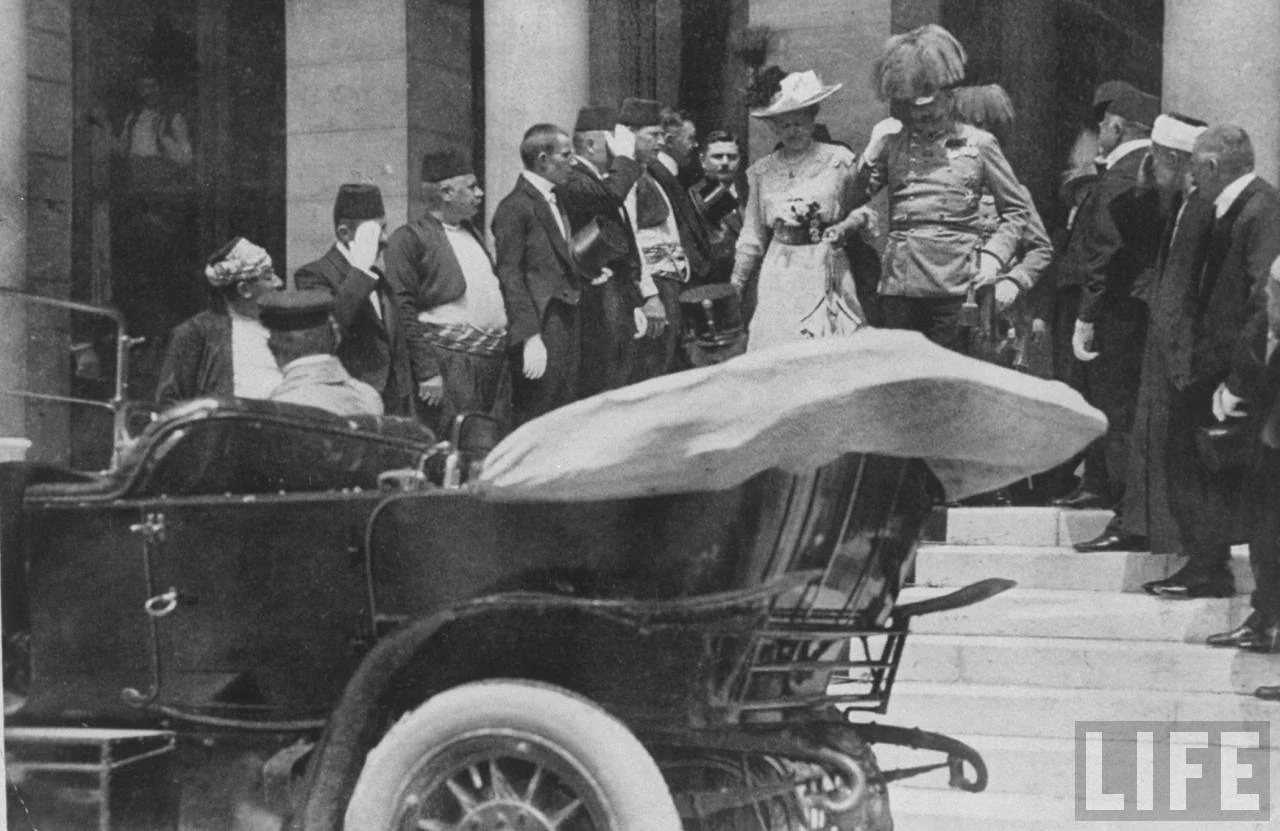
- Franz Ferdinand and Sophie leaving Sarajevo's town hall
- Creator
- Photographer unknown
- Work date
- 28 June 1914
- Collection and image
- Photographer unknown
- How the image relates to the event
- Historical record directly related to the event
- Context
- Taken on the day of the assassination, not at the instant of the shooting. The source file's LIFE mark is retained.
- Rights
- CC0
- Image preparation
- The source image’s full composition and proportions are preserved; no AI generation, repainting or invented detail.
02 / THE MECHANISM
Why did it change the world?
German backing for Austria-Hungary and calculations about timing and prestige hardened commitments. Diplomacy and mobilisation increased pressure, while preparations were read as reasons to act first. Institutions constrained choices without removing responsibility.
03 / THE OTHER SIDE
What must not be overlooked?
Soldiers and civilians bore the consequences of political gambles. An automatic-alliance story erases diplomatic choices; blaming one gunshot erases longer rivalries and cumulative decisions.
04 / BACK TO TODAY
What does it ask of our responsibilities today?
International organisations can examine escalation and staff protection. They should identify who can pause irreversible actions, which signals require independent review, and whether performance pressure turns another party’s precautions into assumed hostility.
05 / A HYPOTHESIS TO TEST
How could understanding lead to action?
Run a tabletop crisis exercise for a cross-border team with conflicting reports and delays. Assess decision traceability, mistaken escalations and staff-contact coverage, not speed alone.
A QUESTION TO TAKE WITH YOU