1543
Copernicus publishes a heliocentric model
What changes when the observer is moving too?
Step into this moment ↗What did this moment leave behind?
01 / THE DOCUMENTED EVENT
What happened?
In 1543, De revolutionibus placed Earth among the planets orbiting the Sun and used Earth’s rotation to explain daily celestial motion. It retained circles and complex geometry, extending earlier ideas rather than settling astronomy at once.
1543 marks publication, not the first heliocentric idea or universal confirmation.
Sources and historical context
- Stanford Encyclopedia of Philosophy — Nicolaus Copernicus ↗
Supports The 1543 work, heliocentric model, retained circular motion and ancient precedents.
Source relationship Independent historical synthesis drawing on Copernicus and associated records.
- Royal Museums Greenwich — De revolutionibus first-edition catalogue ↗
Supports The museum catalogue identifies Petreius and the 1543 edition.
Source relationship Object cataloguing checks the edition; it is not a second astronomical observation.
The image, its author and source
- Work
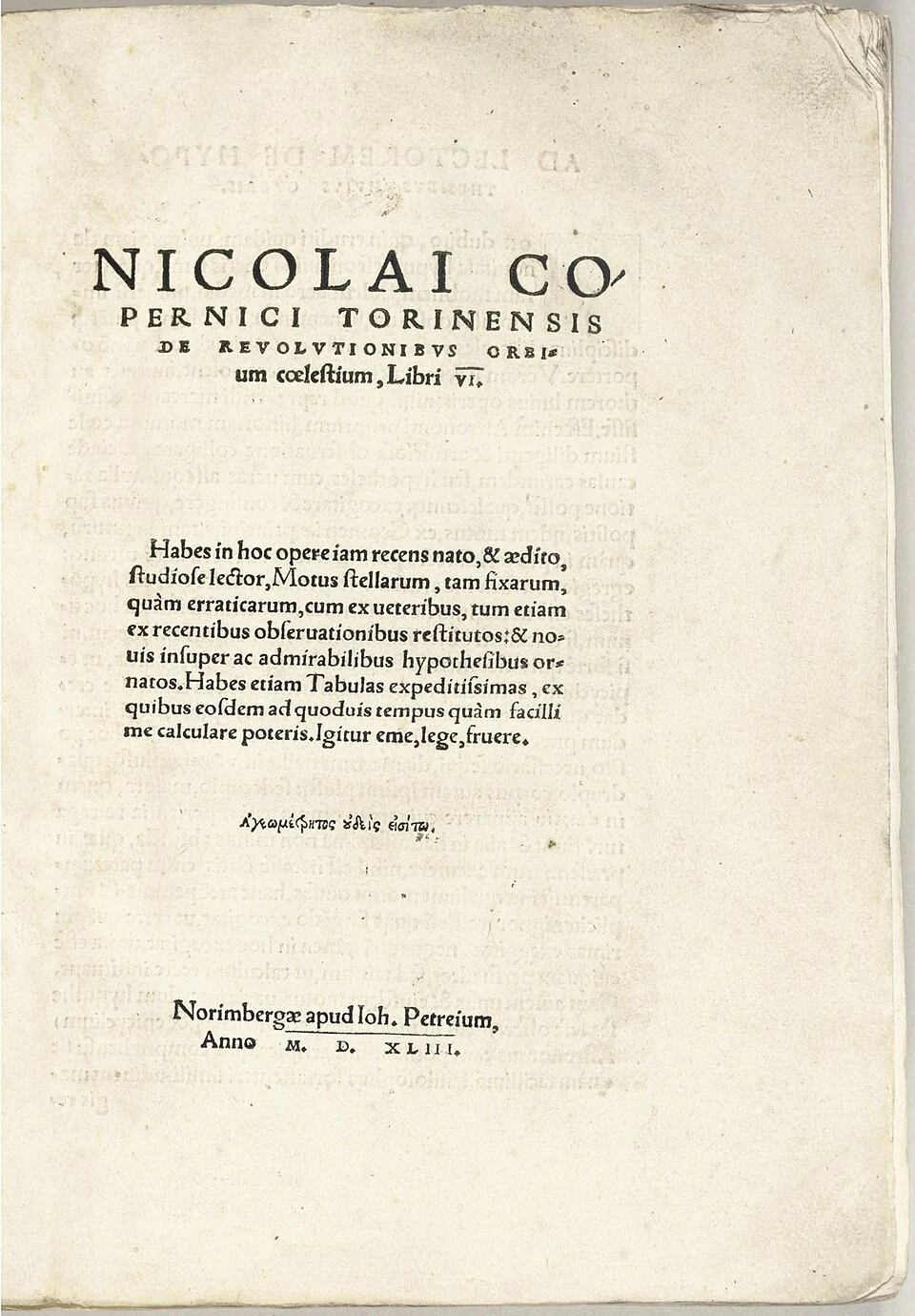
- De revolutionibus orbium coelestium, title page
- Creator
- Nicolaus Copernicus; printed by Johannes Petreius
- Work date
- 1543
- Collection and image
- Johann Petreius / Wikimedia Commons
- How the image relates to the event
- Original object / historical artefact
- Context
- An image of the title page of the 1543 edition. It witnesses a cosmological model entering public argument, not society accepting heliocentrism on publication day.
- Rights
- Public domain
- Image preparation
- The source image’s full composition and proportions are preserved; no AI generation, repainting or invented detail.
02 / THE MECHANISM
Why did it change the world?
The new frame made apparent retrograde motion partly a consequence of relative planetary motion. Observers became part of the explanation, creating predictions to compare; stronger observational and theoretical support came later.
03 / THE OTHER SIDE
What must not be overlooked?
Rearrangement did not immediately simplify every calculation or displace old cosmologies. Acceptance crossed mathematics, natural philosophy and religious authority; a lone-genius story erases predecessors and incomplete evidence.
04 / BACK TO TODAY
Where does this change our business thinking?
A company may mistake its own position for the market’s centre. Teams can map customer tasks, substitutes and their own offer, then compare behavioural predictions instead of treating a new diagram as innovation.
05 / A HYPOTHESIS TO TEST
Where could a small experiment begin?
Pilot churn research with a subscription business, tracking former customers’ alternatives. Compare it with the price-only explanation; expand only if it predicts later churn reasons and supports repeatable improvements.
A QUESTION TO TAKE WITH YOU