331 BCE
Gaugamela and Alexander's conquests
A battle changed borders; the resulting world belonged to more than its victor.
Step into this moment ↗What did this moment leave behind?
01 / THE DOCUMENTED EVENT
What happened?
In 331 BCE, Alexander defeated Darius III’s army at Gaugamela and advanced into Achaemenid centres of power. A Babylonian astronomical diary preserves a contemporary account of the defeat. Subsequent conquests and successor kingdoms brought regions into new political relationships.
331 BCE dates Gaugamela; the diary day is conventionally converted to October 1, but the display retains the year. Successor kingdoms belong to a longer aftermath.
Sources and historical context
- Livius — A Contemporary Account of the Battle of Gaugamela ↗
Supports Babylonian diary records battle, desertion and Alexander’s arrival in Babylon; editorial conversion dates the campaign to 331 BCE.
Source relationship A modern edition of a Babylonian tablet from a tradition distinct from Greek heroic narratives; restorations and commentary remain distinguishable.
- The Metropolitan Museum of Art — Art of the Hellenistic Age and the Hellenistic Tradition ↗
Supports Conquests of 334–323 BCE, successor kingdoms after 323 and artistic-cultural interaction.
Source relationship Distinct scholars combine material and historical synthesis, supplying aftermath rather than another battlefield witness.
- Balassone et al., PLOS ONE — Geological spotlight on the Alexander Mosaic ↗
Supports Roman-period mosaic production at Pompeii, its usual Issus interpretation and an alternative Gaugamela hypothesis.
Source relationship Object research with museum collaborators is distinct from the battle tablet; it supports image dating and limits, not battlefield composition.
The image, its author and source
- Work
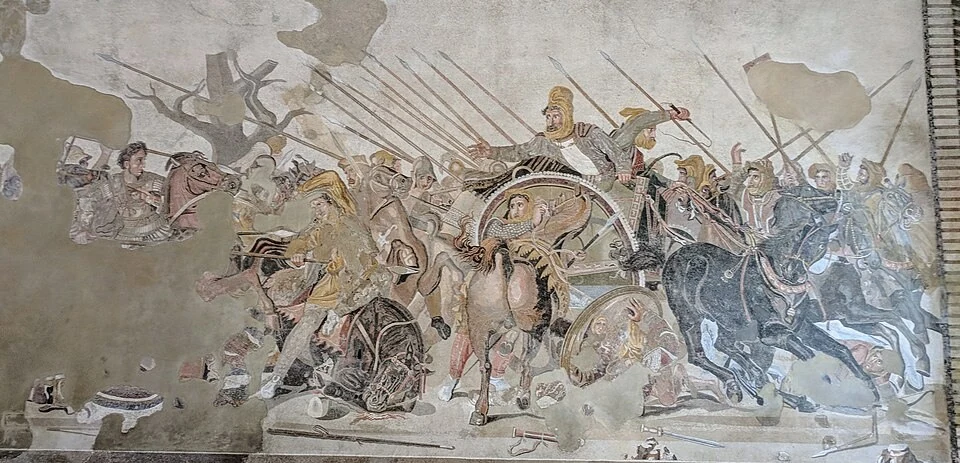
- Alexander Mosaic
- Creator
- Unknown mosaicist
- Work date
- c. 100 BCE
- Collection and image
- TyB / Wikimedia Commons
- How the image relates to the event
- Original artwork / artistic interpretation
- Context
- The Pompeian original is in the National Archaeological Museum of Naples. Usually interpreted as the Battle of Issus, it represents the later image of Alexander's conquests; it is not a record of Gaugamela in 331 BCE.
- Rights
- CC BY 2.0
- Image preparation
- The source image’s full composition and proportions are preserved; no AI generation, repainting or invented detail.
02 / THE MECHANISM
Why did it change the world?
Victory altered control of cities and resources without erasing existing societies. After Alexander’s death, successor kingdoms fragmented his realm, while Greek-language culture and local traditions interacted. Existing routes and populations mattered alongside military power; exchange was not one conqueror’s creation.
03 / THE OTHER SIDE
What must not be overlooked?
Images of conquest can obscure those killed, displaced or forced to submit. Later cultural interaction does not cancel violence or imply free participation. Greek narratives and Babylonian material emphasize different aspects of defeat; heroic detail should not fill their gaps.
04 / BACK TO TODAY
Where does this change our business thinking?
For modern regional integration, the analogy concerns responsibility after control changes: understanding existing knowledge, services and relationships. Control does not create trust. Organizational restructuring should preserve affected people’s choices and remedies, measuring continuity and workload as well as integration.
05 / A HYPOTHESIS TO TEST
Where could a small experiment begin?
For an organization joining two regional teams, map one support process jointly. Ask staff to identify hidden work and exceptions; track handoff omissions, rework and hours. Revise if integration merely transfers costs to one side.
A QUESTION TO TAKE WITH YOU