c. 40000 years ago
The Lion Man: imagination takes form
An imagined being acquired a physical form.
Step into this moment ↗What did this moment leave behind?
01 / THE DOCUMENTED EVENT
What happened?
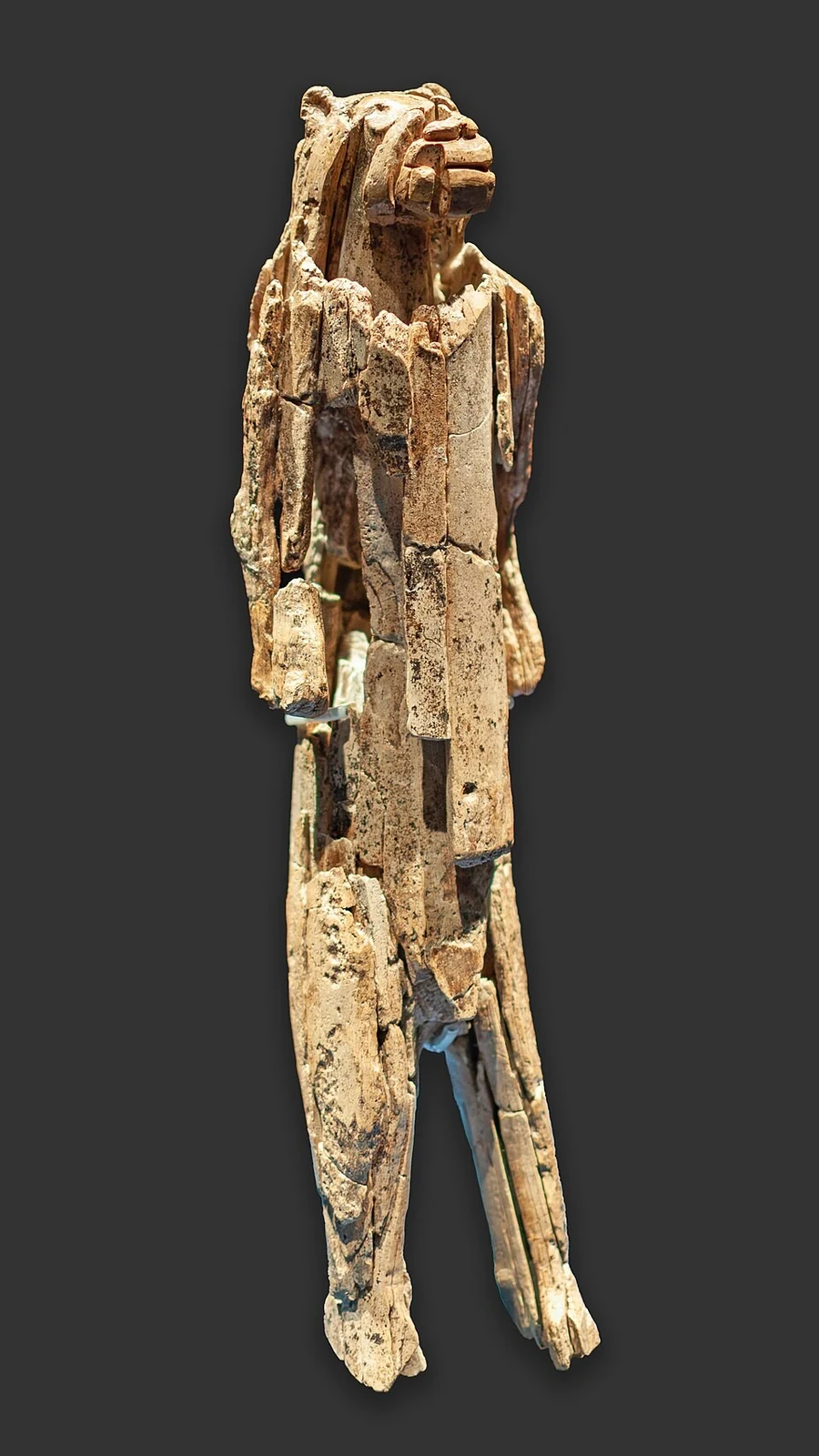
About forty thousand years ago, a maker in what is now Germany carved mammoth ivory into a being combining a feline head with an upright human form. Found in Hohlenstein-Stadel Cave and held by Museum Ulm, the Lion Man gave an imagined combination a lasting material presence.
Estimated Aurignacian age of approximately forty thousand years, not an exact carving date or 40000 BCE.
Sources and historical context
- Museum Ulm — Archaeology ↗
Supports Museum custody, mammoth ivory, cave provenance and the museum’s approximate forty-thousand-year age.
Source relationship Both are Museum Ulm interpretations of the same object, not independent dating tests.
- Museum Ulm — M–Z exhibition text booklet, Hybrid ↗
Supports Page 3 describes the hybrid anatomy, mammoth ivory and unresolved meaning.
Source relationship Both are Museum Ulm interpretations of the same object, not independent dating tests.
- Hugo Obermaier Society — Claus-Joachim Kind, The Smile of the Lion Man, 2014 meeting abstracts p. 33 ↗
Supports Excavator reports 2008–2013 renewed excavations, ivory fragments in 1939 backfill and the 2012–2013 reassembly.
Source relationship A first-hand excavator abstract published by a different institution; it concerns the same object and collaborative restoration, not independent confirmation of its forty-thousand-year age.
The image, its author and source
- Work
- Lion Man
- Creator
- Unknown maker
- Work date
- c. 40,000 years ago
- Collection and image
- Dagmar Hollmann / Wikimedia Commons
- How the image relates to the event
- Original object / historical artefact
- Context
- The original mammoth-ivory sculpture is held by Museum Ulm. Its human–lion form is evidence of symbolic making, not a record of a witnessed mythical event or a claim to the world's earliest art. Photographed in 2013.
- Rights
- CC BY-SA 4.0
- Image preparation
- The source image’s full composition and proportions are preserved; no AI generation, repainting or invented detail.
02 / THE MECHANISM
Why did it change the world?
The sculpture recombines observed bodily features into something others could encounter without meeting it in nature. It preserves an early meeting of abstraction and skilled making, not evidence that one person invented imagination. Material and form remain accessible; the complete original story does not.
03 / THE OTHER SIDE
What must not be overlooked?
Without an accompanying text, viewers may project their own myths or identity categories onto the figure. A specific deity, ritual purpose or male identity requires further evidence. Vivid storytelling should preserve rather than erase those limits.
04 / BACK TO TODAY
Where does this change our business thinking?
For creative teams, the analogy is making an unbuilt idea tangible enough to discuss together. A model can communicate more than a slogan, but it should distinguish evidence from conjecture; visual concreteness can otherwise make untested assumptions appear established.
05 / A HYPOTHESIS TO TEST
Where could a small experiment begin?
Pilot an object-observation lesson with museum educators. Compare two groups using interpretation that separates established facts from hypotheses. Assess evidence recognition, material recall and questions generated; success means better understanding, not greater mystification.
A QUESTION TO TAKE WITH YOU