What did this moment leave behind?
01 / THE DOCUMENTED EVENT
What happened?
On 4 October 1957 the Soviet Union placed Sputnik 1, the first artificial satellite, into Earth orbit. Its radio signal demonstrated orbital access. It was neither crewed flight nor an already mature space service.
1957 marks Sputnik 1 becoming the first artificial Earth satellite on 4 October, an orbital milestone distinct from crewed flight or commercial space services.
Sources and historical context
- NASA — Sputnik Ushers in the Space Age ↗
Supports 4 October 1957 launch, radio signals and rocket background.
Source relationship Mission retrospective based on established Soviet and Cold War records.
- Roger D. Launius — Sputnik and the Origins of the Space Age ↗
Supports Date, first artificial Earth satellite and US institutional response.
Source relationship A separately authored historical synthesis, hosted by NASA and sharing basic launch records.
The image, its author and source
- Work
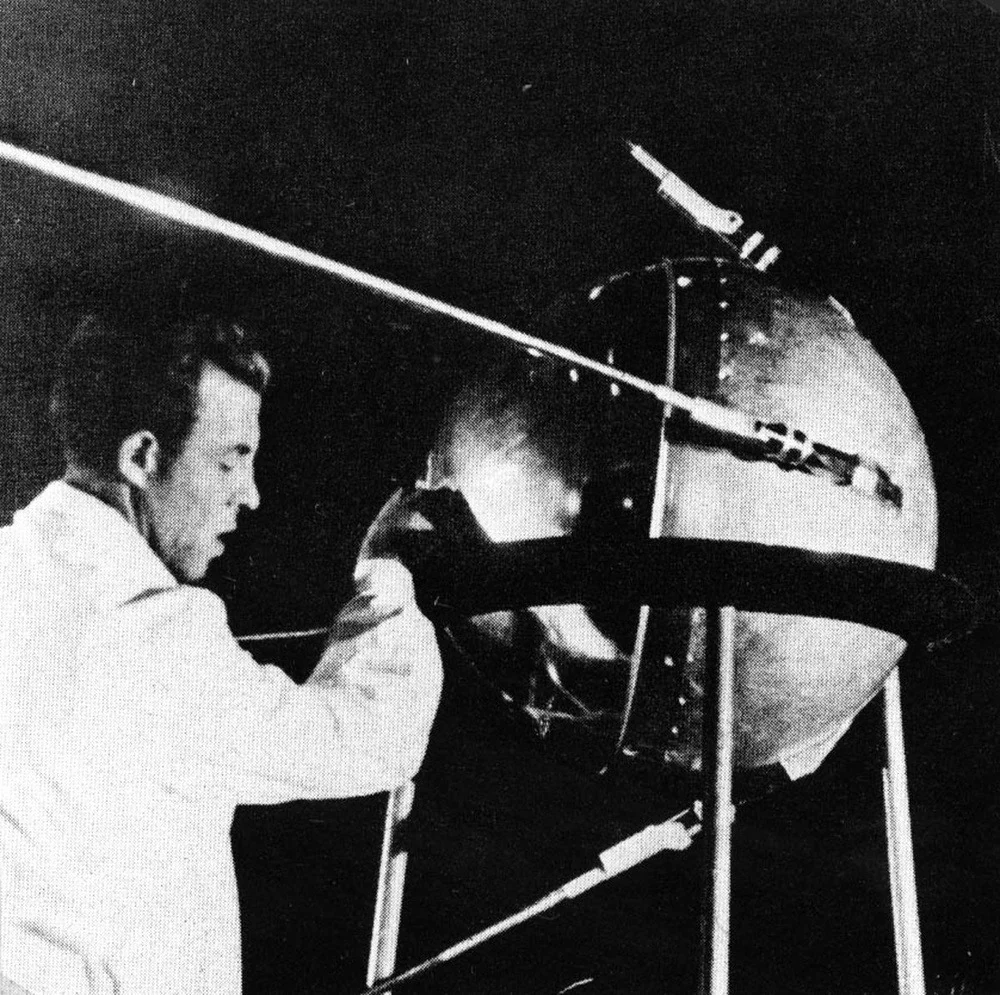
- A technician preparing Sputnik 1
- Creator
- Photographer uncredited; supplied by NASA
- Work date
- Autumn 1957
- Collection and image
- Photographer uncredited; supplied by NASA
- How the image relates to the event
- Historical record directly related to the event
- Context
- DVIDS/NASA record SPD-SLRSY-1626 identifies the assembly-shop scene as autumn 1957. The page's 2009 and 2012 dates concern the digital record, not the historical exposure.
- Rights
- Public domain
- Image preparation
- The source image’s full composition and proportions are preserved; no AI generation, repainting or invented detail.
02 / THE MECHANISM
Why did it change the world?
Orbital access opened possibilities for repeated observation, navigation and communication. It also signalled national capability and encouraged institutional investment, while useful services still required ground systems and sustained missions.
03 / THE OTHER SIDE
What must not be overlooked?
Rocket capability intersects with military power and resource competition. Spacecraft have finite power and lifetimes and can leave objects in orbit. Successful launch is only one measure of a programme.
04 / BACK TO TODAY
Where does this change our business thinking?
A demonstration can open a market without proving a service business. Begin with the customer’s required outcome on the ground, then derive data, communication and reliability needs.
05 / A HYPOTHESIS TO TEST
Where could a small experiment begin?
A remote-reservoir operator could compare existing satellite data with ground measurements. Measure anomaly-detection delay, false alerts and inspection trips before considering any new space hardware.
A QUESTION TO TAKE WITH YOU